
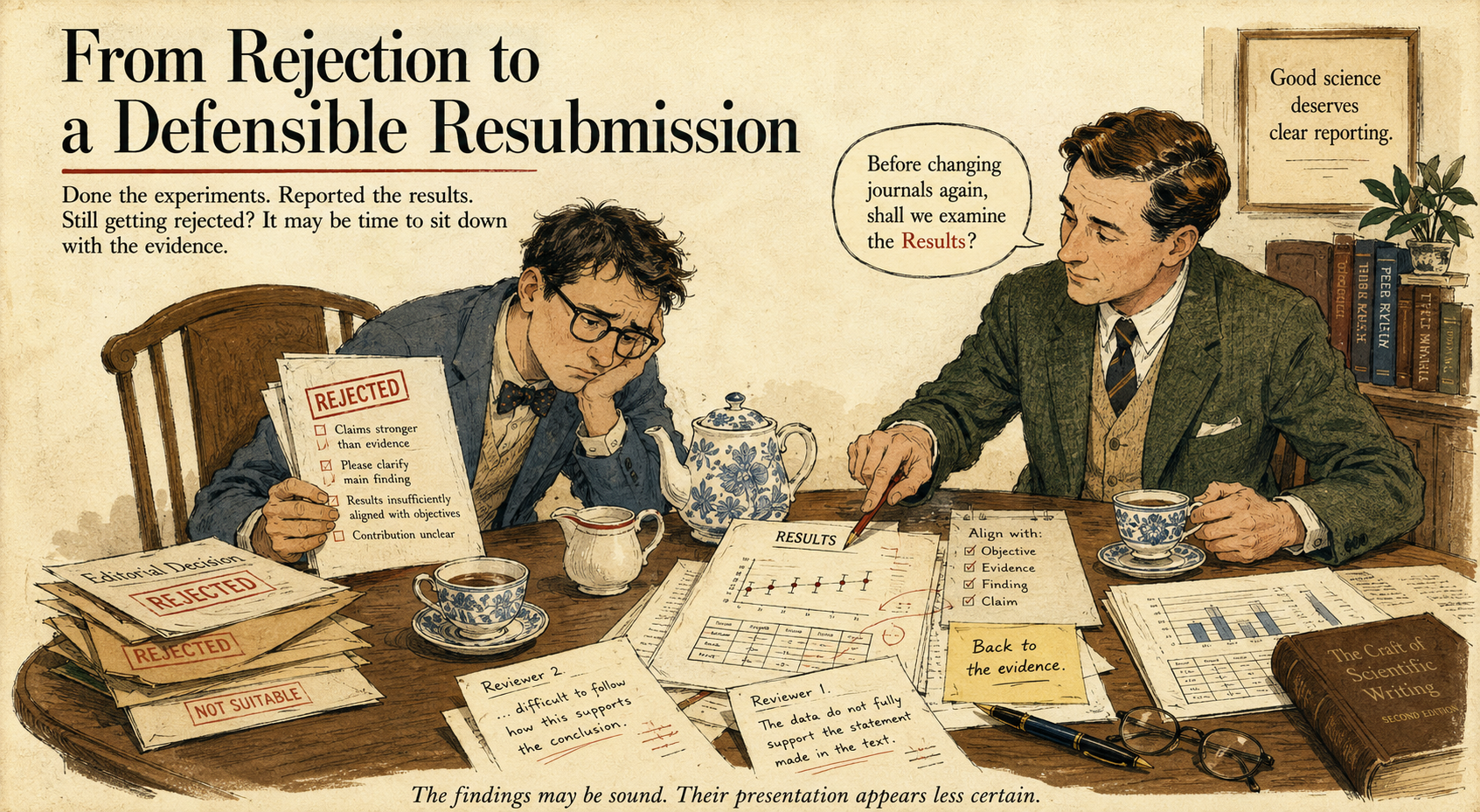
By the time he came to us, he had stopped asking, “Which journal should I try next?” His question had become quieter: “Is my research simply not good enough?”
He had received several rejection letters. He needed to understand how to write a Results section in a research paper so the evidence could be traced. The letters used different words, but together they showed a pattern: the Results did not clearly answer the research questions; important findings were compressed into a few lines; some claims travelled further than the evidence; null or unexpected findings were barely visible; and the Discussion sounded more confident than the Results allowed.
Those signals are not proof that the Results section alone caused rejection. Manuscripts are also rejected for journal mismatch, weak novelty, design or analysis problems, and editorial priority. Published work on rejection also identifies scope, novelty, methodology and presentation as recurring concerns [1]. See RE4U’s Autopsy of Desk Rejections for the wider picture.
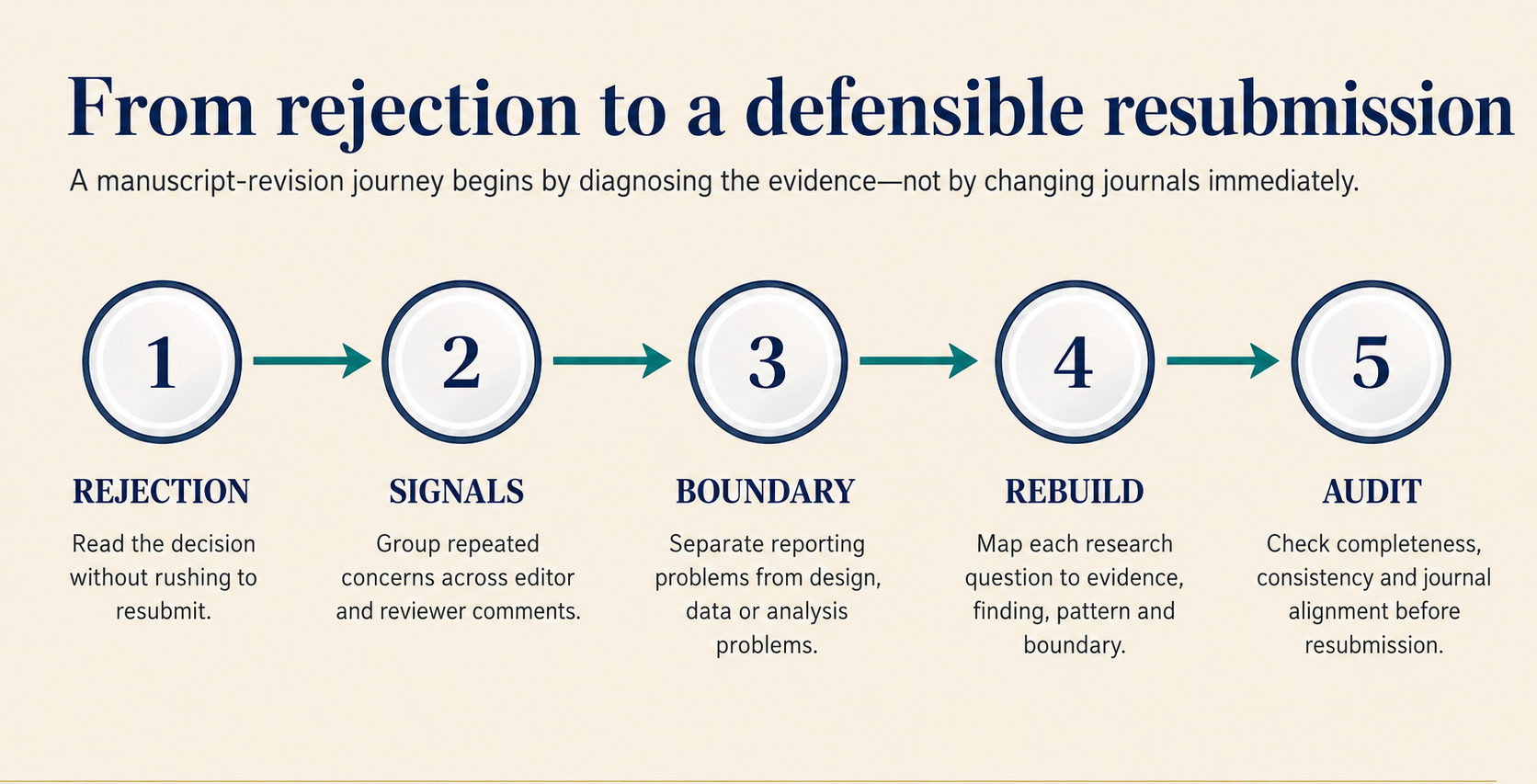
Figure 1. The rejection-to-revision journey: diagnose reviewer signals, separate study problems from reporting problems, rebuild the evidence path and audit before resubmission.
What is the Results section, really?
Answer: The Results section tells the reader what your study found and shows the evidence supporting each research question. It should make the path from question to finding easy to follow—without claiming more than the design and data can support. |
Springer Nature advises authors to present results in a logical order and avoid duplicating the same data across text, tables and figures [2].
Can better writing actually solve the problem?
Writing can repair a Results section when the evidence is valid but poorly organised: findings do not follow the objectives, the central pattern is buried in software output, claims are overstated, or tables and text disagree.
But clearer sentences cannot rescue an unsuitable design, missing controls, inadequate data or invalid analysis. Ethical support improves communication; it does not manufacture a contribution. RE4U’s terms state that support is advisory and editorial, while scientific validity, authorship and final responsibility remain with the researcher. If the analysis is uncertain, seek a data review first.
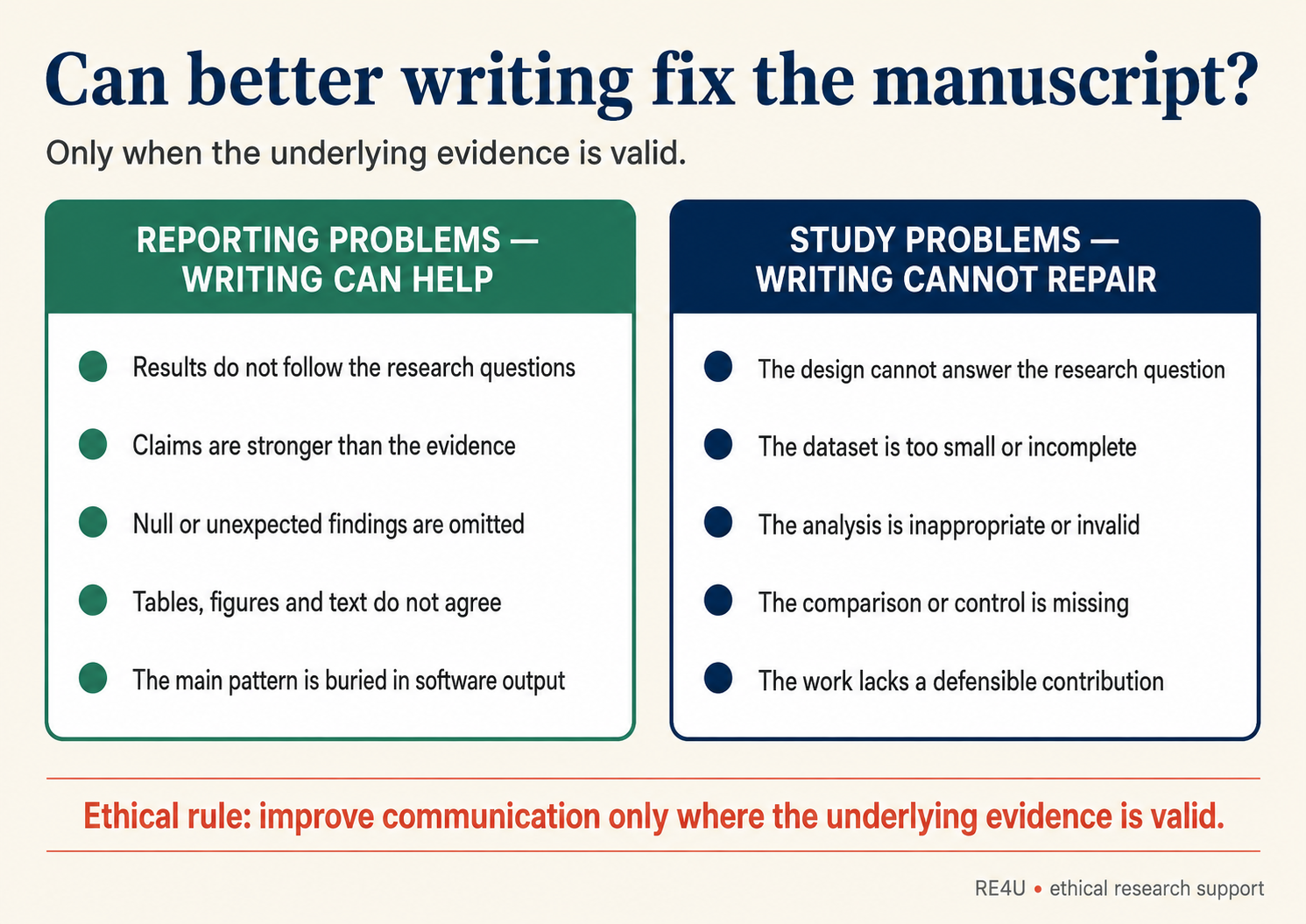
Figure 2. The ethical boundary between reporting problems that clearer writing can improve and study problems that require methodological or analytical correction.
Start with the RE4U Results Map
If the page is blank, do not begin by trying to sound academic. Take one research question and walk through five moves.
· Question: What exactly must this subsection answer?
· Evidence: Which analysis, quotation, observation or measurement answers it?
· Finding: What did that evidence directly show?
· Pattern: What changed, differed, repeated or stood out?
· Boundary: What was uncertain, non-significant, contradictory or missing?
Now turn those moves into a paragraph: Finding → evidence → pattern → boundary.
Example: “Participants receiving the intervention reported lower stress scores than the control group. The adjusted mean difference was 4.2 points, with a 95% confidence interval of 2.1–6.3. The pattern was consistent across most subgroups. However, no clear effect was observed among participants older than 50.” |
The paragraph became traceable.
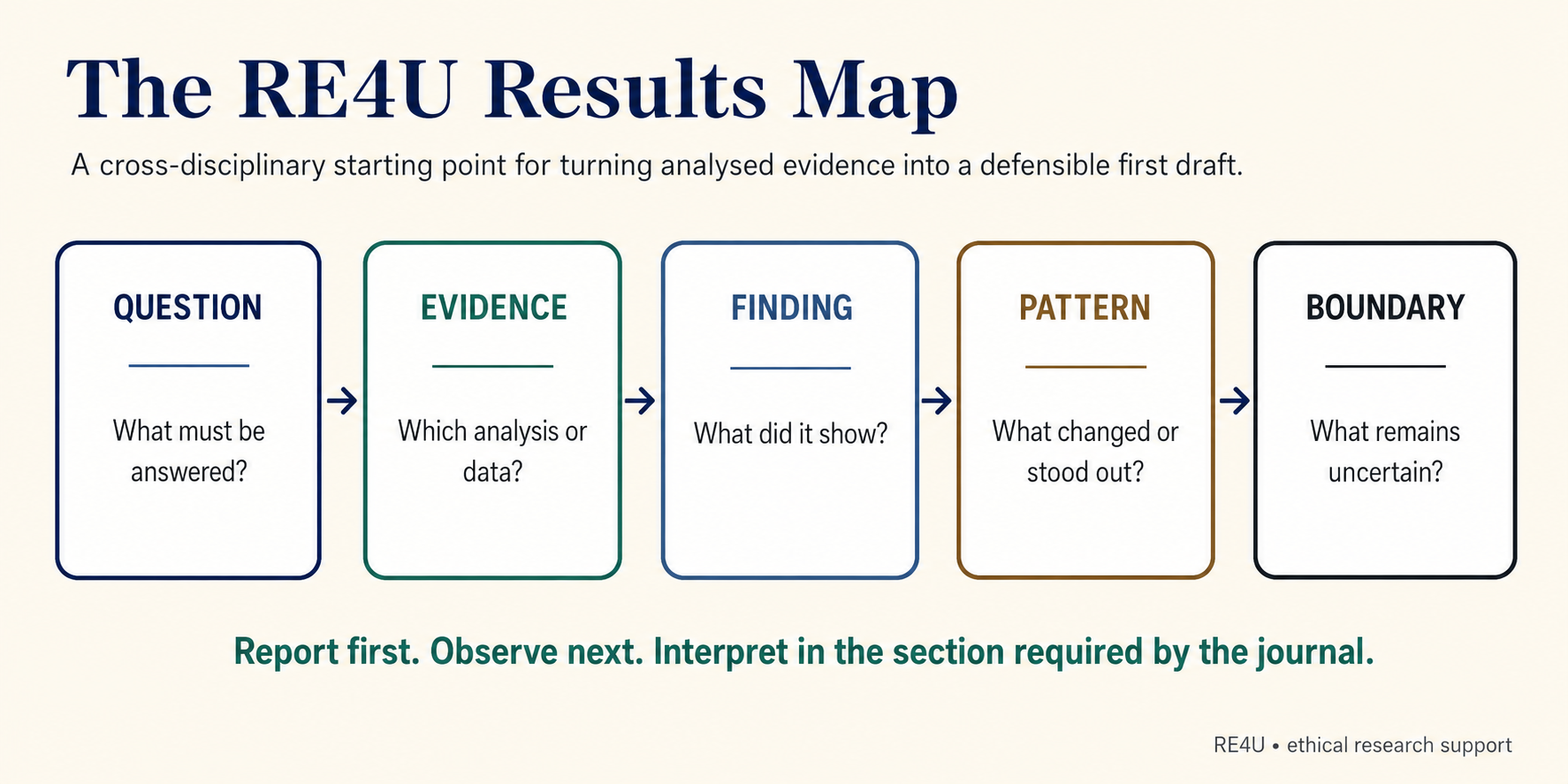
Figure 3. The RE4U Results Map: research question → evidence → finding → pattern → boundary.
Web alt text: Five-step RE4U Results Map showing question, evidence, finding, pattern and boundary.
Match the route to your study type
APA’s Journal Article Reporting Standards provide separate guidance for quantitative, qualitative and mixed-methods studies, while EQUATOR helps researchers choose reporting guidelines by study design [3,4].
· Quantitative: Estimate → comparison → uncertainty.
· Qualitative: Theme → analytic explanation → data extract → variation or negative case.
· Experimental/laboratory: Condition → measured response → control → repeatability or uncertainty.
· Mixed methods: Finding from each strand → convergence, complementarity or contradiction.
A quotation alone is not a qualitative finding. A p-value alone is not a quantitative story. A laboratory change without a control or replicate is difficult to judge.
Report the whole evidence—not only the convenient part
A weak sentence might say: “The intervention improved performance.” A more trustworthy version says: “Performance improved overall; however, the effect was not clear in one subgroup, and eight follow-up records were unavailable.”
It lets the reader judge the study fairly. Reporting guidelines are designed to support complete and transparent reporting so readers can critically appraise, interpret and use research [5]. Null findings, exceptions and missing data are part of that evidence—not embarrassing leftovers.
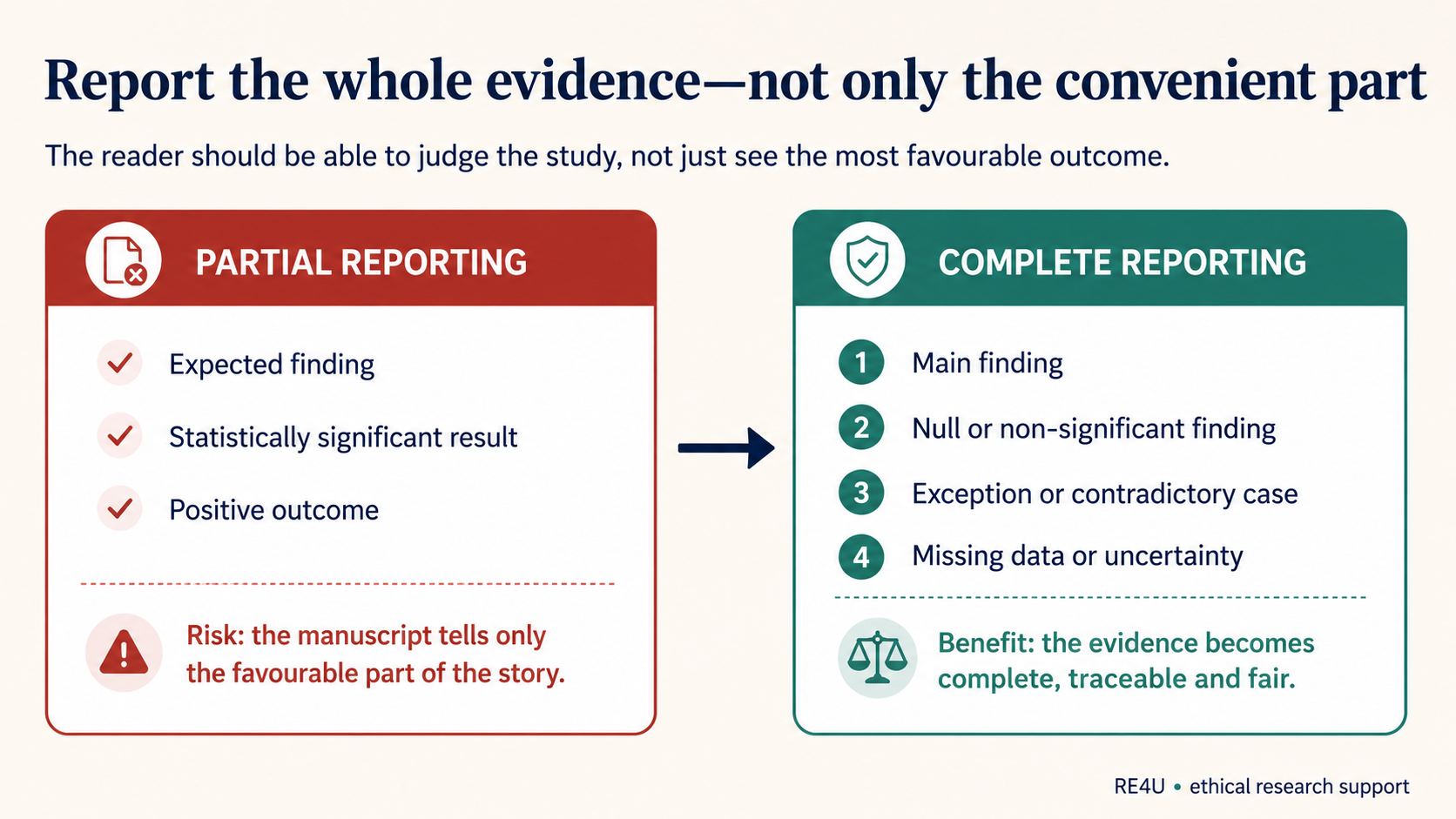
Figure 4. Complete reporting lets readers judge the evidence rather than seeing only the favourable result.
Web alt text: Split visual comparing selective reporting of positive results with complete reporting that includes null findings, exceptions and uncertainty.
Before you resubmit, ask six questions
· Answered: Does every objective have a clear result?
· Supported: Does every important claim have evidence?
· Complete: Are null findings, exceptions and uncertainty visible?
· Consistent: Do the text, tables and figures agree?
· Separated: Have you kept reporting and interpretation in the sections required by the journal?
· Aligned: Have you checked the reporting guideline and journal instructions for your study type?
This is not a universal formula or a guarantee of acceptance. It is a practical starting point for a clearer first draft.
If you want to review your results so that it won’t face rejection connect with us

Frequently asked questions
Can a weak Results section lead to manuscript rejection?
It can contribute when reviewers cannot see how the evidence answers the research questions, when claims exceed the data, or when important findings are omitted. Rejection may also result from journal fit, novelty, design, analysis or ethics.
How do I start the Results section of a research paper?
Map each research question to the evidence that answers it. Then state the main finding, give the supporting value or extract, identify the important pattern and report any relevant uncertainty or exception.
What is the difference between Results and Discussion?
Results report what the study found. Discussion explains what the findings mean, how they relate to previous research and why they matter. Some journals combine them, so always follow the target journal’s instructions.
Should non-significant or unexpected results be included?
Yes, when they answer a planned question or materially affect interpretation. Report them accurately with uncertainty and context. A non-significant result does not prove that no effect exists.
How should tables and figures be used in the Results section?
Use tables for exact values and comparisons, figures for visible patterns or relationships, and text for the main takeaway. Do not repeat every table cell or describe a figure without explaining the result it supports.
Sources and further reading
[1] Bhende et al. (2024), “Decoding the Rejection Code: Understanding Why Articles Get Axed.”
[2] Springer Nature, “Results: Writing a Manuscript.”
[3] APA Style, “Journal Article Reporting Standards (JARS).”
[4] EQUATOR Network, “How to Write a Great Research Paper Using Reporting Guidelines.”
[5] SPIRIT–CONSORT, reporting standards for complete and transparent trial reporting.